Are you planning a swing gate or looking to add an opener? Choose your situation in the table. We’ll show you what to measure, which parts go together, and what to prepare before fabrication and concreting. Open the details directly from the relevant question.
Find the right solution for your driveway
| Your situation | Go straight to |
|---|---|
| New gate, manual for now | 4 × 1.5 m example: frame, hinges, and preparation for a future opener |
| Existing gate, looking for an opener | Manual test, measurements, and choosing a kit |
| Short or sloping driveway | Space for a car · slope measurement example |
| Wide masonry pillar | Linear-opener brackets or articulated arm |
| I want privacy and a solid infill | What to check when covering an existing gate |
| Choosing a stop or drop bolt | Finished paving, low car, and the right keeper |
| I need pedestrian or emergency access | One pedestrian gate leaf · power failure |
What to measure · 4 × 1.5 m example · What to order together · Information needed for a recommendation
The 4 m × 1.5 m example is intended to explain the process. Adapt the dimensions, construction, and hardware to your driveway; this is not a universal fabrication drawing. Install the opener only after the completed gate passes a successful manual test.
Preparation sequence: survey → select the gate leaf, hardware, and opener together → drawings and building preparation → fabrication and manual testing → opener installation and commissioning.
What to measure before choosing parts
Use a tape measure to measure the finished opening between the pillars at both the top and bottom. Mark the centerline of each hinge, the finished paving height, and where the car will be parked on your sketch. If the leaves are unequal, assess each one separately.
| Item | What to check on site |
|---|---|
| Clear opening | The clear distance between the finished pillars, both at ground level and at gate height. |
| Ground | The highest point along the full travel path of both leaves, not just beneath the closed gate. |
| Opening | Direction, required angle, and clearance from the car, wall, fence, or path. |
| Pillars | Material, condition, load-bearing core, and space for the hinge and opener bracket. |
| Leaves | Length from the hinge axis, weight of the finished leaf, and infill type. |
| Operation | Manual or powered operation, wind exposure, and number of opening cycles. |
A detailed guide to measuring the space and driveway slope helps identify potential clashes before fabrication.
Illustrative example: 4 m clear opening, 1.5 m frame
4,000 mm is the opening between the finished pillars; 1,500 mm is the frame height. Determine the length of each frame only after selecting the hinges, stop, and any overlap. Don’t simply divide the opening into two 2-metre frames—you also need space for the hardware and operating clearances.
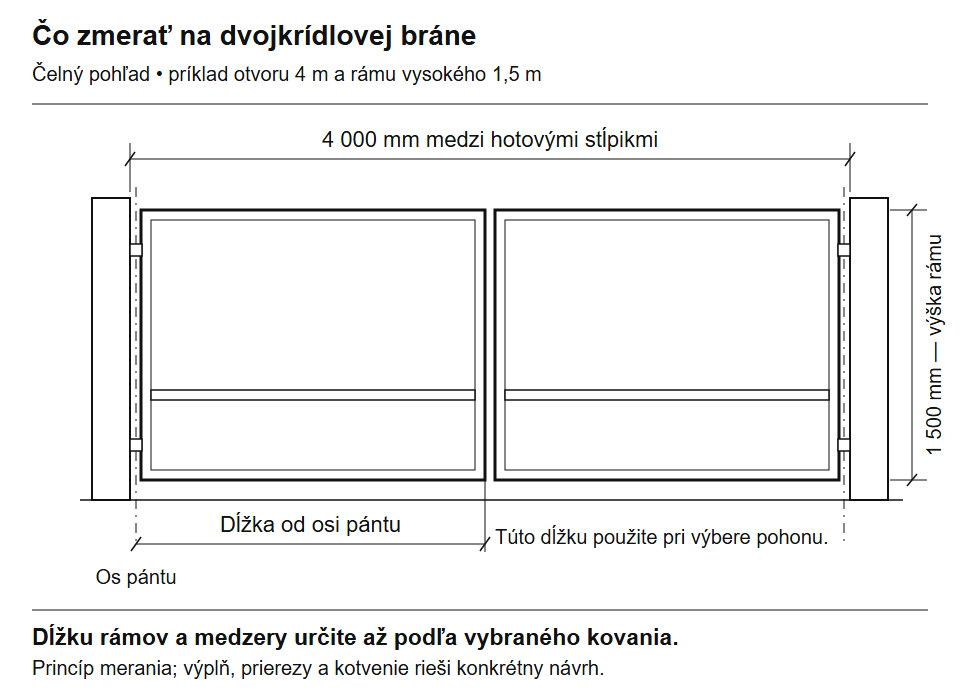
The infill has been omitted for clarity. One horizontal rail illustrates a possible frame layout; it does not specify the cross-section or bracket position. Click to enlarge.
To choose an opener, measure the leaf from the hinge axis to its far edge. Use the frame fabrication drawing when ordering the profiles. These are two different dimensions.
Which parts you need together
First decide how the gate will be operated. This affects how the leaves are secured and what the order includes.
| Your gate | What to select |
|---|---|
| Manual double-leaf gate | Hinges and fixings, stops and hold-open catches for the leaves, a drop bolt for the passive leaf with a keeper and a lock to suit the required level of security. |
| With an opener now or later | In addition to the gate hardware, include brackets and suitable load-bearing mounting points, control unit, wiring, and safety devices. Check the required stops and, if needed, an electric lock and emergency access. |
Compare the complete system: the price of the motor alone does not include all the required parts or building preparation. For an underground opener, also check the housings, manual release, and drainage; for a manual gate, check the drop-bolt keeper and hold-open catches.
How to check what’s included in a kit and choose compatible parts
All the guides in one place
| What you need to figure out | Guidance and parts selection |
|---|---|
| Will the leaves fit in the driveway? | Measuring the slope, outward opening and folding leaves. Mark the travel path and the space for the car. |
| What should you build the gate from? | Frame, profiles, pillars and foundations, hinges, infill and surface protection. Choose these together with the load-bearing mounting points for the brackets. |
| Which opener should you choose? | Opener type, 24 V or 230 V and the limits of individual models. Assess the length and weight together. |
| Will the brackets fit? | Installation geometry: Wingo A/B/C and charts, HOPP arm or underground opener. |
| What should you prepare and connect? | Wiring and MC424LR30 example. Next manuals, installation and testing and maintenance and troubleshooting. |
| How do you secure and operate the gate? | Stops, gate latch and keeper, electric lock and controls and backup power. Choose according to whether the gate will be operated manually or automatically. |
What to send us to help select parts and an operator
For an initial recommendation, please prepare:
- A sketch of the opening, showing the length and height of each leaf, the direction of travel, and the opening angle.
- The infill type and the weight of the finished leaf; for a new gate, a list of materials so we can estimate the weight.
- Three photos: the entire entrance from the yard, a close-up of the hinge and post from above, and the area where the leaf will open. Include measurements with the close-up—a photo alone is not enough.
If the ground is sloped, include surface-height measurements along the path of the leaves. If an operator is already installed, also photograph its data plate and the control unit’s identification label.
Looking for a specific part only? See hinges, gate latches, stops or swing gate operators. When replacing a part, also compare the installation drawing and the original part’s keeper.
We’ll select parts to suit your entrance
Send us the measurements and photos. We can help compare suitable hinges, stops, and operator kits, and check that there is enough room to install them.
| Continue based on what you need help with |
|---|
| Space, slope, and opening · All scenarios and examples |