Components for sliding gates from fortamigo.ie
Gate and fence components, operators and infill
Choose components and kits for building a gate, gate and fence infill, or structural profiles. We also offer gate operators and installation guides.
Gate kits and components
What we offer: build your own sliding gate






We serve everyone who wants to build cantilever sliding gates and track sliding gates themselves, or make gates for other people. We offer sliding gate components of high quality, with short delivery times and at a fair price.
Building a swing gate or pedestrian gate? Take a look at our components and operators for swing gates and pedestrian gates.
We supply customers with the components needed to build a gate, together with guides so they can assemble, install and get the gate running with minimal experience themselves. We provide delivery and advice about your gate.
To make choosing easier, we have put together sliding gate component kits. We’ll be happy to help you choose. If you have a specific request, email [email protected].
Information about gate structures
Sliding gates
| Sliding gates are classified by how they move as follows: | |
| Cantilever sliding gates: |
the gate is carried above the ground by a C-profile that runs in support carriages |
|---|---|
| Track sliding gates: |
the gate has wheels fixed to its bottom edge that run along a track |
| Suspended sliding gates: |
the gate has carriages at the top that run inside a C-profile fixed to the ceiling or wall |
The following illustrations give you an idea of the individual components of a sliding gate:
Cantilever sliding gate
Cantilever gates are popular for their design, which allows maintenance-free operation and does not require level ground. The gate is carried approximately 5 to 10 cm above the ground by a C-profile, which is anchored outside the opening width on two support carriages, securely anchored in a concrete foundation. However, bear in mind that the gate needs more space to slide open—approximately 30 to 40% more than the opening width.
Layout of cantilever sliding gate components
|
Click a specific part of the image to view the relevant product category. |
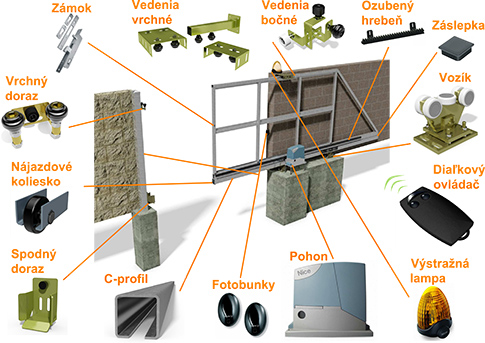
How a cantilever sliding gate works
The key components of a cantilever gate are C-profile and the gate frame. The gate frame can be made from closed, thin-walled steel sections. A C-profile is welded to the bottom of the frame. This profile allows the gate to move horizontally on bearings incorporated into two support carriages. The carriages are anchored in the concrete foundation. At the top of the gate, movement is stabilised by gate guide (top or side), which will not damage the gate's finish through friction. Gate stops are handled by bottom and top stops.
The C-profile is made of high-quality cold-rolled steel and does not expand. The carriage bearings are precisely matched to the C-profile and are protected from dirt by end caps. The support carriages can be adjusted in height and can pivot, ensuring that the bearings on the carriage are loaded evenly.
In most cases, an electromechanical operator is used together with safety devices (photocells, , a warning light). However, the gate can also be opened manually; in this case, it can be locked with a hook lock with a handle or pull. We offer our customers NICE operators because of our excellent experience with this brand.
Cantilever gate frame construction
The gate is constructed with a frame made from closed steel sections. Build the frame from 40 × 40 mm, 60 × 40 mm, 80 × 40 mm or other sections, depending on the size and weight of the gate. The overall load-bearing capacity of the gate frame depends on the material used to weld it together. As the size of the box sections used increases, so does the frame's rigidity and therefore the load-bearing capacity of the gate infill.
Approximate calculation of the total length of a cantilever gate: Multiply the opening width by 1.4 and add 0.2 m (required for the gate guide). Example: the opening is 4 m wide. Calculation: 4 m × 1.4 + 0.2 m = 5.8 m (the total gate length is 5.8 m). This approximate calculation applies to gates weighing up to 600 kg; for heavier gates, the factor may be as high as 1.6, depending on the gate's weight.
If you are planning a lightweight frame, you can use a shorter gate overhang. As the gate's weight increases, it is better not to shorten the overhang; allow for a factor of at least 1.4 as a guide.
Gate frame infill
You can customise the gate infill to suit the style of your fence or home (wooden slats, steel infill, plastic sections, polycarbonate, expanded metal, etc.).
Related links cantilever gate
| More information: links |
|
|---|---|
|
Component kits for cantilever gates: For convenience, we offer complete kits containing the components needed to build a cantilever gate. The kits are available at discounted prices. |
|
|
Choosing components for a cantilever gate: Detailed information on choosing components for a cantilever gate. |
|
|
Recommended dimensions are provided in the guide Concrete foundation for a cantilever gate. |
|
|
Frequently asked questions when building a cantilever sliding gate. |
|
Track sliding gate
Track sliding gate Also known as a ground-track gate, it runs along a track installed on a concrete foundation. Steel track wheels with bearings are fixed to the bottom section of the gate.
Track sliding gate component layout
|
|
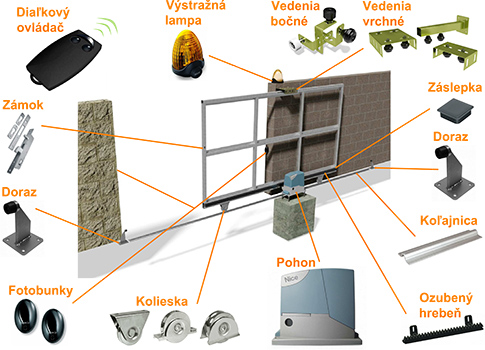
How a track sliding gate works
The main component is the gate frame, track and track wheels. Build the gate frame from closed, thin-walled steel sections, which provide the frame with rigidity. The gate wheels are attached to the bottom of the frame (there are several mounting options; see track wheels for a track gate). These wheels allow the gate to move horizontally along the track. The track is anchored along the full width of the opening and the full length of the gate's travel. The side guide and stabilisation of the gate leaf against lateral movement are provided by gate guide (top or side), which will not damage the gate's finish through friction. Gate stops are handled by bottom and top stops.
In most cases, track gates are fitted with an electromechanical operator together with safety devices (photocells, warning light). However, the gate can also be opened manually, in which case it can be locked. with a hook lock with a handle or pull handle. We offer our customers NICE gate operators because of our excellent experience with this brand.
Related links track-mounted gate
| More information: links |
|
|---|---|
|
Component kits for track-mounted gates: for convenience, we offer complete kits containing the components needed to build a track-mounted gate. The kits are available at discounted prices. |
|
Comparing cantilever and track-mounted gates
The main difference lies in how the gate is designed to slide: Cantilever gate is guided along the bottom by a C-profile that runs on two support carriages anchored beyond the opening, whereas a track-mounted gate has wheels fixed to the bottom frame profile that run along a track. Compare these options in light of the conditions on your property:
| Cantilever sliding gate | Track-mounted sliding gate | |
|---|---|---|
|
Cantilever gates are among the most modern and popular systems for opening and closing a property's entrance. Installing a cantilever gate offers the following advantages: |
Track-mounted gates are especially useful where there is not enough room for a cantilever gate. The slightly lower purchase cost of a track-mounted gate is also worth considering: |
|
|
Advantages |
» maintenance-free operation: the lowest maintenance requirements of all gate types |
» lower purchase price than a cantilever gate |
|
Disadvantages |
» requires more room to slide open: the space must be approximately 30–40% wider than the opening |
» requires a track on a solid foundation along its entire travel path, both across the opening and in the run-back area |
Summary: First consider the available space in each situation. This factor can sometimes rule out a cantilever gate straight away, making it unnecessary to consider other factors. Otherwise, a track-mounted gate is slightly less expensive than a cantilever gate, but requires more maintenance in winter. Some people may not mind the maintenance, while others expect the convenience of opening the gate in any weather during winter. It also depends on personal preference and habits. In general, however, both sliding systems are very well designed; each is simply suited to a different situation.
Components for large gates
We also offer a solution for gates with an opening width of more than 6.5 m. Our components can be used to build cantilever, track-mounted and swing gates for openings up to 15 m wide. The bottom guide C-profile for cantilever gates is also available in a 140 × 140 × 6 mm size with matching carriages. We can also recommend a suitable track capable of withstanding the axle load of a fully loaded truck. Gate operators are also available for gates weighing up to 3500 kg (NICE TUB3500). Components for large sliding gates.
If you are interested, contact us, and we will try to find the right solution for you and recommend the necessary components
Two counter-sliding gates
If a sliding gate needs to cover a wide opening, you could also consider using two gates that slide in opposite directions, each covering half of the opening. Synchronization is supported by older NICE ROBUS operators as well as the newer RBS models using the slave unit so that the two gates sliding in opposite directions are synchronized and controlled by a single remote.
Top-hung sliding gate
Another option is a top-hung sliding gate. This ceiling-mounted system has a C-profile fixed above the opening. Bearing carriages run inside the C-profile, with the gate attached to them. Our range also includes components for top-hung gates:
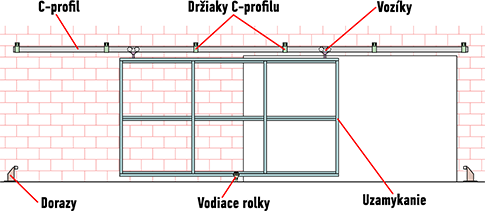
| The top-hung system consists of the following components: | |
| Supporting components |
- C-profile is fixed to the ceiling, a beam or a wall. Three C-profile sizes are available: 34 × 31 × 2.0 mm, 42 × 52 × 2.5 mm, 57 × 67 × 3.0 mm. Choose the size according to the weight of the structure. |
|---|---|
| Guide section |
- guide rollers prevent the gate from moving sideways. The use of guide rollers is shown in the diagram suspended gate track. |
| Optional accessories |
- locks to secure the suspended gate. Standard hook locks for sliding gates |
|
See the complete range and technical information on suspended gates. |
|
Components and operators for swing gates and pedestrian gates
For building or repairing a swing gate or pedestrian gate, we offer components ranging from frames and hinges to locks and operators. We'll be happy to help you choose parts that work well together.
Essential components for swing gates and pedestrian gates
- Structural profiles – for making gate and pedestrian-gate frames.
- Hinges and pivots – for mounting and adjusting the gate leaf.
- Locks and electric locks – for closing and locking.
- Handles, knobs and escutcheons and pull handles – for easy opening of the pedestrian gate.
- Stops and keeper plates and drop bolts – for defining the position and securing the gate leaf.
- Swing gate operators – for automatic opening.
All components for swing gates and pedestrian gates »
You can find the operator table and wiring requirements in the section swing gate operators.
Gate and Fence Infill
Match your gate's appearance to your fence and home with the right infill. Choose from six main categories:
- Aluminium slats for gate and fence infill
- Flat ZN profiles – galvanised infill profiles
- Galvanised Z-shaped slats
- FE slat system – untreated steel slats
- Stainless steel INOX slats
- WPC composite fence boards
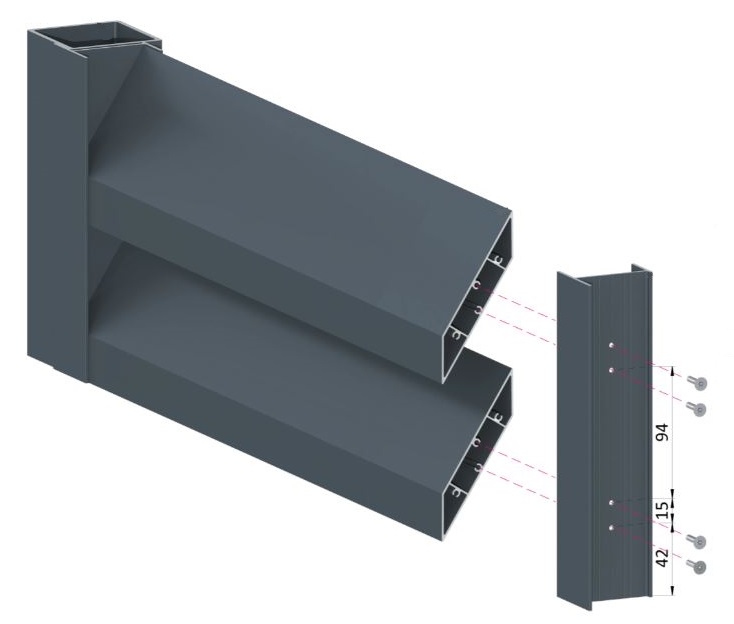
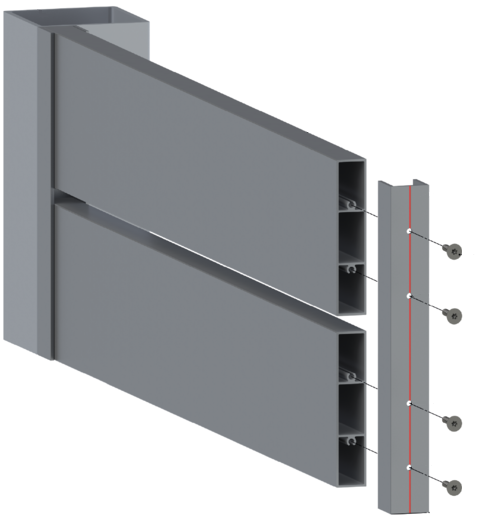
Examples of aluminium infill. The full range of aluminium slats for gates and fences is available in our store.
Find more options in our complete range of gate and fence infill.
Operators, controls and wiring
Sliding gate operators
The operator is installed outside the opening width and is usually fitted with safety devices (photocells, warning beacon). Choose the power supply and wiring requirements to suit the specific operator. If the power fails, the operator can be released with a key so the gate can be operated manually in an emergency. A well-adjusted gate mechanism ensures smooth movement, so even a child can open the gate by hand. The operator has a stop system and is fitted with limit switches.
Preparing wiring for a sliding gate
When preparing for the gate installation, remember to allow for cables to the operator, photocells, warning beacon and any control button. You can find the required cables and cross-sections in our guides for each operator and control unit:
Find more diagrams, manuals and instructions on the NICE technical support. The specific cable selection also depends on cable length and the accessories used.
Choosing a gate operator
 We supply our customers with operators from the Italian brand NICE, which we use in our own installations and have been very happy with for many years.
We supply operators individually or in value bundles that include remotes, safety photocells, a warning beacon and other accessories. The RBS400 (D), RBS600 (D) and RBS800 (D) kits include a four-channel MYGO4 remote, allowing you to control several compatible devices independently (e.g. a garage door, lighting, etc.).
When choosing an operator, consider the gate's weight and length, the number of opening cycles per day, and especially how smoothly it runs. Our range includes operators for gates weighing up to 400, 600, 800 and 1,000 kg, as well as more powerful models. For an initial guide, we provide recommendations and operator kits with recommended accessories:
| As a general guide, we recommend up to | Operator / kit (including manuals) | Operator manual |
|---|---|---|
| 250 kg | NICE ROAD RD400 | NICE ROAD RD400 manual |
| 250 kg | NICE ROBUS RBS400 (D) | NICE ROBUS RBS400 manual |
| 400 kg | NICE ROBUS RBS600 (D) | NICE ROBUS RBS600 Manual |
| 650 kg | NICE ROBUS RBS800 (D) | NICE ROBUS RBS800 Manual |
| 700 kg | NICE ROBUS RB1000 | NICE ROBUS RB1000 Manual |
| 1200 kg | NICE RUN1800 | NICE RUN1800 Manual |
| 2000 kg | NICE RUN2500 | NICE RUN2500 Manual |
The weights in the table are upper guideline limits for our recommendations, not the manufacturer's maximum ratings. For a long gate, a slope, frequent use, or harsh winters, allow for a larger safety margin. The operator may have enough force to move the gate, but when choosing one, we also consider its service life and reliable operation in tougher conditions.
The gate's mechanical resistance is key. Even two people may struggle to move a 100 kg gate, while a well-built 500 kg gate can be moved with two fingers. It depends on the slope, quality, and correct choice of carriages or rollers, their installation, and guide adjustment. The gate should move easily along its entire travel path. A more powerful operator should not be used to compensate for faulty mechanics. Even if the gate moves easily, the operator's weight and length limits must be observed.
There is a solution for gates on a slope, too. Depending on the slope and the specific configuration, this may include a hydraulic resistance brake, which controls the gate's movement downhill. However, the brake does not replace the operator's reserve capacity for moving uphill.
If you need help, get in touch. We'll review the dimensions, weight, and conditions, then select components and an operator that work well together.
Sliding gates can also be divided into residential and industrial types according to the number of opening cycles per day. We're happy to help you choose an operator.
NICE operators for double-leaf gates
For automatic opening of double-leaf gates, we offer Wingo, Toona, and HOPP kits, as well as S-Fab and M-Fab underground operators. Selected BE2 kits include two operators, a control unit, a remote control, a pair of photocells, and a flashing light. Click a kit's name to see its exact contents.
The Wingo WG2024 and WG3524 kits include an MC424LR30 control unit, an INTI2 remote control, a pair of EPM photocells, and an ELDC flashing light.
| Kit with photocells and flashing light | Length of one leaf* | Power supply | Documentation |
|---|---|---|---|
| NICE Wingo WG2024 (BE2) | up to 2 m | power supply: 230 V AC motors: 24 V DC | Manual |
| NICE Wingo WG3524 (BE2) | up to 3.5 m | power supply: 230 V AC motors: 24 V DC | Manual |
| NICE Toona TO4024 (BE2) | up to 3 m | power supply: 230 V AC motors: 24 V DC | Manual |
| NICE Toona TO5024 (BE2) | up to 5 m | power supply: 230 V AC motors: 24 V DC | Manual |
| NICE Toona TO7024 (BE2) | up to 7 m | power supply: 230 V AC motors: 24 V DC | Manual |
| NICE Wingo WG4000 (BE2) | up to 2 m | power supply: 230 V AC motors: 230 V AC | Manual |
| NICE Wingo WG5000 (BE2) | up to 3.5 m | power supply: 230 V AC motors: 230 V AC | Manual |
| NICE Toona TO4005 (BE2) | up to 3 m | power supply: 230 V AC motors: 230 V AC | Manual |
| NICE Toona TO4016P (BE2) | up to 3 m | power supply: 230 V AC motors: 230 V AC | Manual |
| NICE Toona TO5016P (BE2) | up to 5 m | power supply: 230 V AC motors: 230 V AC | Manual |
| NICE HOPP (BE2) | up to 2.4 m | power supply: 230 V AC motors: 24 V DC | Manual |
| NICE S-Fab SFAB2024 (BE2) | up to 2.3 m | power supply: 230 V AC motors: 24 V DC | Manual |
| NICE M-Fab MFAB3024 (BE2) | up to 3.5 m | power supply: 230 V AC motors: 24 V DC | Manual (EN) |
| NICE M-Fab MFAB3000 (BE2) | up to 3.5 m | power supply: 230 V AC motors: 230 V AC | Manual (EN) |
This is only a selection of the most commonly used operators. Find the full range of operators for swing gates in this category »
* The lengths shown are the catalogue limits for a single leaf. Assess the permitted length and weight together, according to the limits for the specific model in the manual, for example using the Wingo chart. The maximum length and maximum weight limits do not apply at the same time. When choosing, also consider how smoothly the gate operates, the dimensions of the posts, the options for mounting the operator, and wind load, especially with a solid infill.
Power supply and wiring preparation for swing-gate operators
The listed kits are normally connected to a 230 V AC supply. Depending on the model, the motors themselves operate on 24 V DC or 230 V AC. With HOPP, the control unit is built into the main HO7124 operator, which is supplied with 230 V. Prepare cable routes in advance between the control unit, both operators, the photocells and the warning light.
Choose the wiring according to the specific control unit and its version:
- Wingo WG2024 / WG3524 with MC424LR30 – wiring details in the current manual. Wiring diagrams are on the previous page.
- MC824H – wiring for 24 V Toona and M-Fab operators.
- MC800 – wiring shopping list for 230 V Wingo, Toona and M-Fab operators.
- HOPP – wiring details in the operator manual.
We have separate lists for older control units: MC424LR10 (Wingo and S-Fab SFAB2024) and MC824HR10. For the S-Fab SFAB2024, choose the MC424 documentation that matches the version of the control unit supplied in the kit. More manuals and diagrams are available on the NICE technical support.
Not sure which one to choose? Get in touch with the dimensions of the gate leaves and posts, their approximate weight, and a photo of the installation site. We’ll help you choose the hardware and operator.
Swing gate components and construction · Technical support and more guides
Structural profiles and profile connectors
For building gate and fence frames and other structures, we offer box sections, L-, U- and T-sections, flat bar, tubes and mounting profiles. Choose by material:
- Galvanised steel profiles ZN
- Mild steel profiles FE
- Aluminium profiles AL
- Stainless steel profiles INOX
The range also includes galvanised structural and mounting profiles and profile connectors for joining tubes and box sections.
Technical support and advice
Technical support for NICE operators includes manuals, wiring diagrams and solutions to common issues. For help choosing components, see our advice and component selection assistance.
fortamigo.ie – components, advice and customer projects
We supply DIY enthusiasts and installation companies with quality gate components at fair prices, along with installation guides. Our aim is to help you choose the right components and successfully complete your project.
We’re happy to help you choose components and prepare a quote. Fill in the component selection and advice form or email [email protected]. Company details for Posuvné brány s.r.o. are available on the Contact page.
Your reviews and feedback matter to us. See our customer reviews and photo gallery of DIY-built gates. We’d also love to hear about your experience and see photos of your completed gate. Email them to us to inspire other DIY enthusiasts.
Find more tips in our guide to common issues when building a sliding gate. Also take a look at the benefits of shopping at fortamigo.ie.
Happy shopping and best of luck with your project from the fortamigo.ie team.
Notice: The content of this website is the intellectual property of Posuvné brány s.r.o. and may be shared freely provided it is reproduced in full, including the links, the Posuvné brány s.r.o. company logo and this notice. Neither the content nor any part of it may be modified or distributed without the author's permission. To refer to any part of the content, link to it using a hyperlink. If any of these conditions are not met, please contact us at [email protected]. Operator manuals are excluded from this content; they are the property of the manufacturer, Nice S.p.A. More about content protection.
Page last updated 11.9.2026