What types of gates are there? Comparison of sliding gates
Cantilever, track-mounted and suspended gates
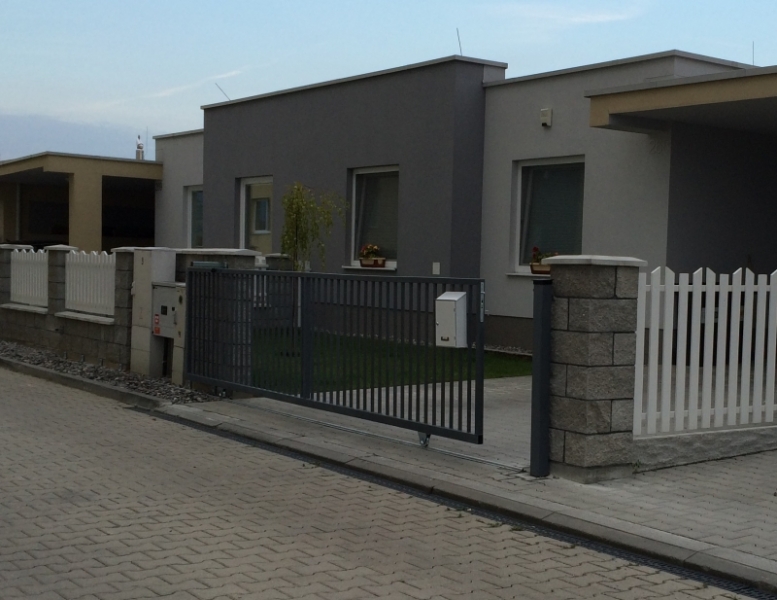
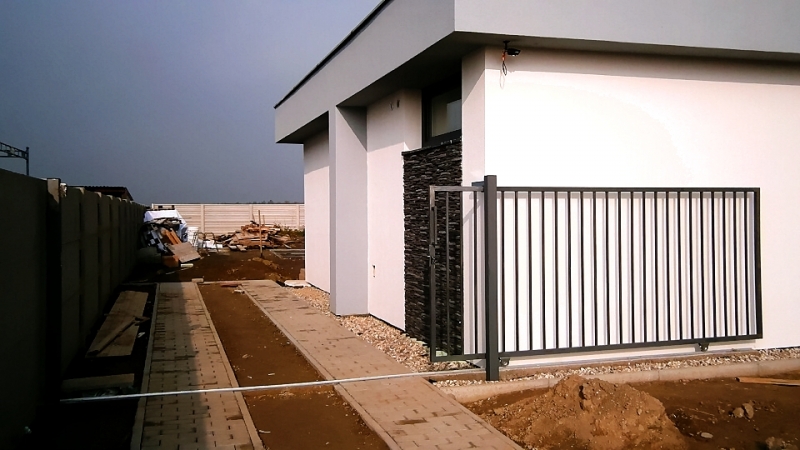
A sliding gate is a type of gate that opens and closes by sliding. These gates are divided into three types: cantilever, track-mounted and suspended.
 |
 |
 |
| Cantilever gate | Track-mounted gate | Suspended gate |
Cantilever sliding gate
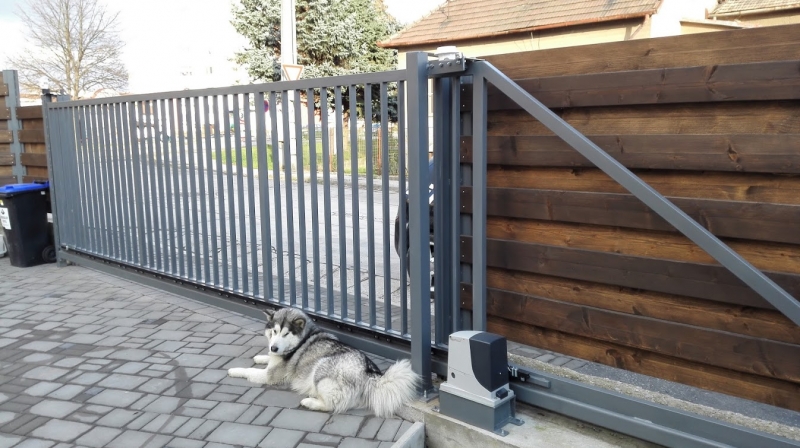
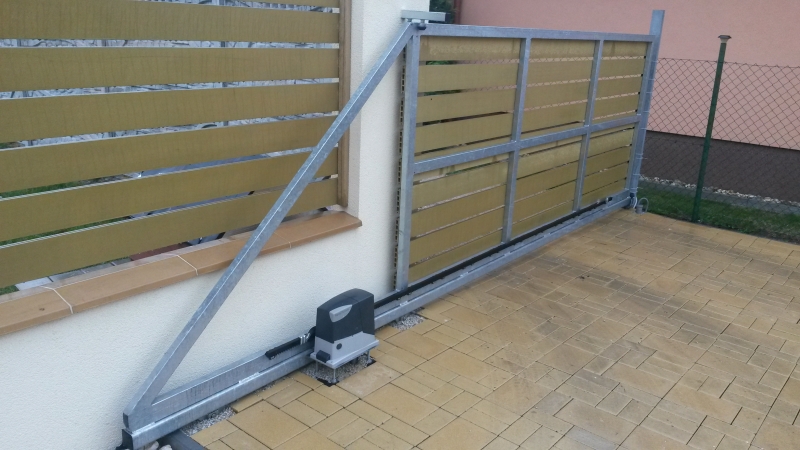
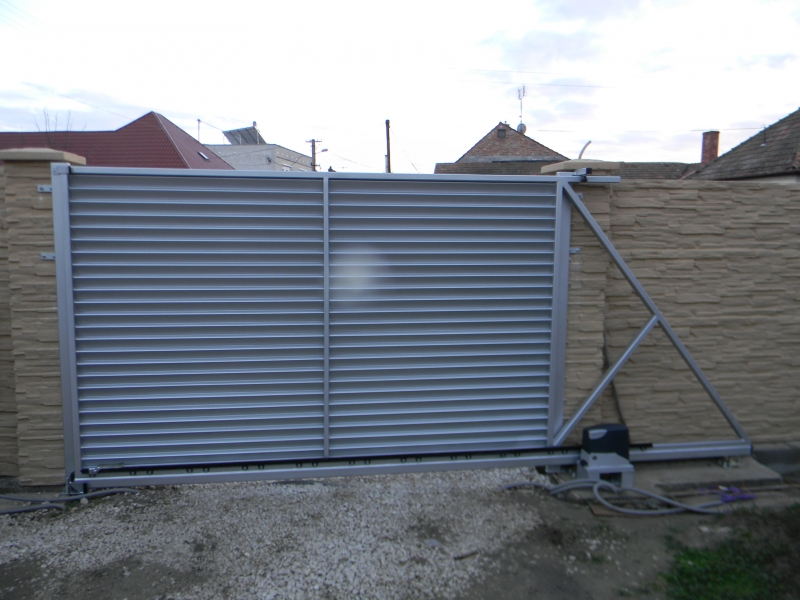
Today, the cantilever gate is one of the most widely used and most modern gate-opening systems.. The anchoring mechanism (support carriages) is located outside the opening, and the load-bearing C-section, to which the gate frame is welded, sits a few centimetres above the ground (approx. 10 cm). As a result, one of the gate’s main advantages is its maintenance-free operation.
Other advantages include
- maintenance-free operation – of all gate types, this requires the least maintenance
- reliable operation in winter
- no modifications to the roadway
- long service life
- sliding mechanism anchored outside the opening
On the other hand, a cantilever gate requires more space than other types. To estimate the total space required, add the space needed to slide the gate open to the width of the opening. Calculate this by multiplying the opening width by a factor of 1.4.
Example: For a 4-metre opening (the distance between the posts), the total space required for a cantilever gate is 4 × 1.4 = 5.6 metres (for the gate to slide open) + 4 metres (opening) = 9.6 metres in total.
The gate needs what is known as a counterbalance section (often visible as the angled section at the end of the gate). Technically, however, this section does not provide any counterbalancing. This section is needed because the support carriages are located outside the opening, and the gate needs a section to slide along.
Did you know...?
Sliding gate components can be used to move more than just gates. A popular use for this system is covering a swimming pool, which also creates a movable terrace. See this solution here: Sliding pool cover system.
 |
 |
 |
Track-mounted sliding gate
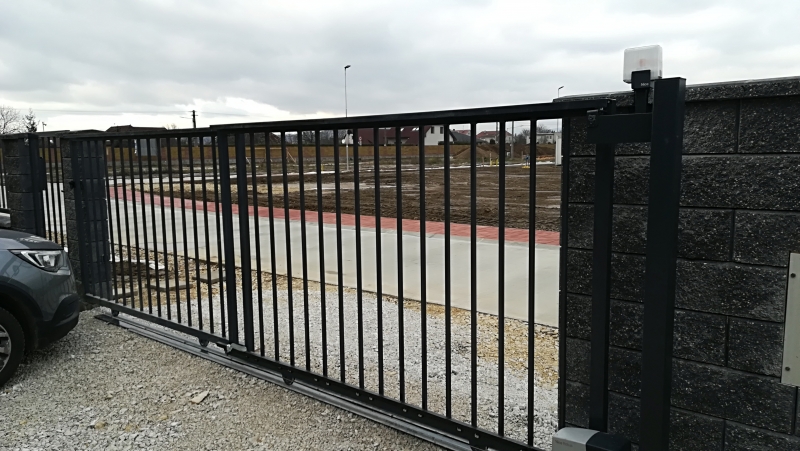
As the name suggests, track-mounted gates need a track to slide along.. The track can be U-shaped or V-shaped. We also stock wheels for both types, which are bolted (or welded) directly to the bottom of the gate. The gate then rolls along the track on these wheels.
This type of gate costs less to buy and also requires less space. Other advantages include:
- lower purchase cost
- less space required – the space needed to slide the gate open is the same as the opening width (+30 cm for overlap)
- no need to dig foundations, as is required for the support carriages of a cantilever gate
- long service life
However, the gate requires some maintenance.. Nothing should obstruct the wheels as they roll along the track – including stones or ice in winter.
It is easy to work out the space needed for a track-mounted gate. The space needed to slide the gate open is the same as the width of the opening..
Example: If you have an opening (the distance between the posts) of 4 metres, you will need a total of 4 metres (for the gate to slide open) + 4 metres (opening) + 30 cm (overlap and clearance) = 8.3 metres.
 |
 |
 |
Suspended sliding gate
A suspended gate is not typically used as an entrance gate, but is often used as a “screen” or sliding wall or sliding door in various sheds and outbuildings, as well as warehouses and industrial halls.
The load-bearing C-section and guide carriages are located at the top of the structure.. The C-section can be fixed with top or side brackets. The carriages (with 2 or 4 rollers) run inside the C-section and are mounted directly on the gate or door that is to be opened (slid aside). At the bottom, only stops and auxiliary guide rollers are needed.
The main advantages of this overhead system include:
- lower purchase cost
- easy installation
- a wide range of applications
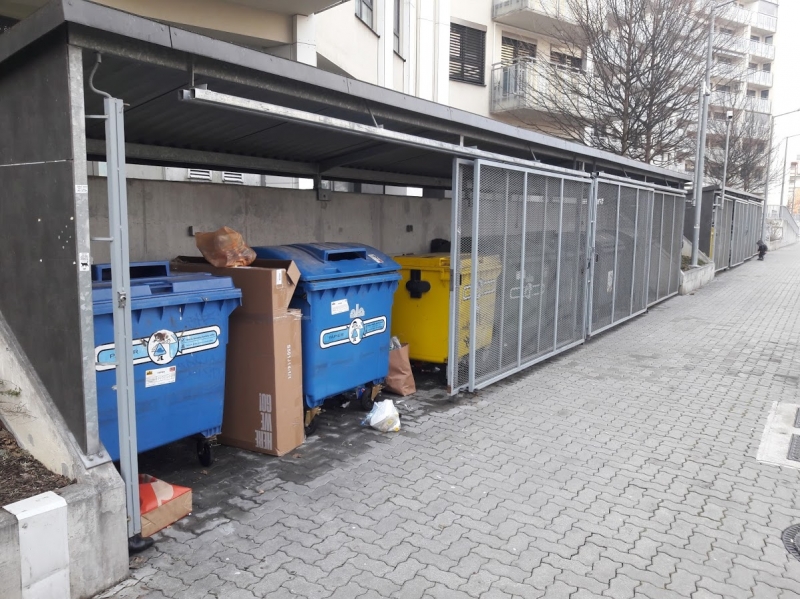
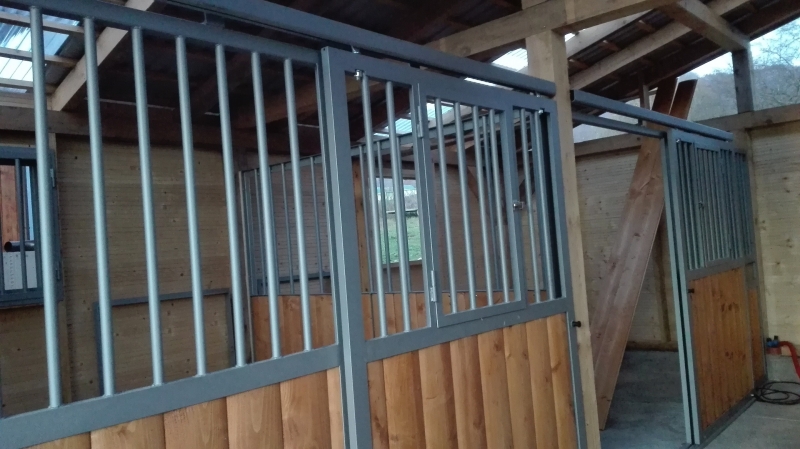
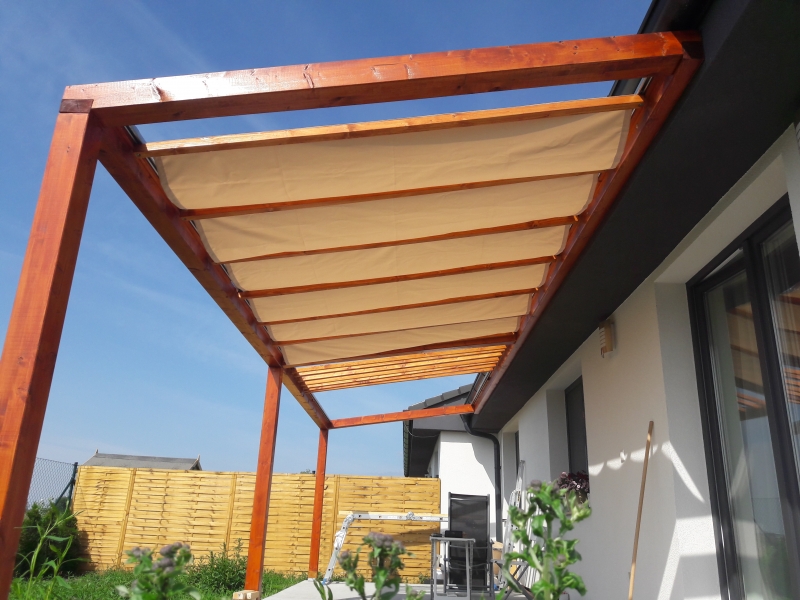
There are many ways to use a suspended system.. Our customers have used suspended systems to create, for example: security for container sites, entrance for horse stabling or sliding terrace cover.
 |
 |
 |