I have limited space for a cantilever sliding gate. What are my options?
Is there not enough room along the fence to slide a cantilever gate open? It depends on whether there is not enough room for the counterbalance tail, for the entire gate leaf, or whether the gate needs to turn around a corner as it opens. You can choose the right solution based on that.
Quick selection based on your property
Without a track across the opening
- Not enough room for the counterbalance tail: Intelligate.
- The leaves need to slide alongside each other: telescopic cantilever gate.
- You have room on both sides of the entrance: two opposing gates.
With a track across the opening
- There is room for the entire leaf, but not for the counterbalance tail: conventional track gate.
- You need less room to slide the gate open: telescopic track gate.
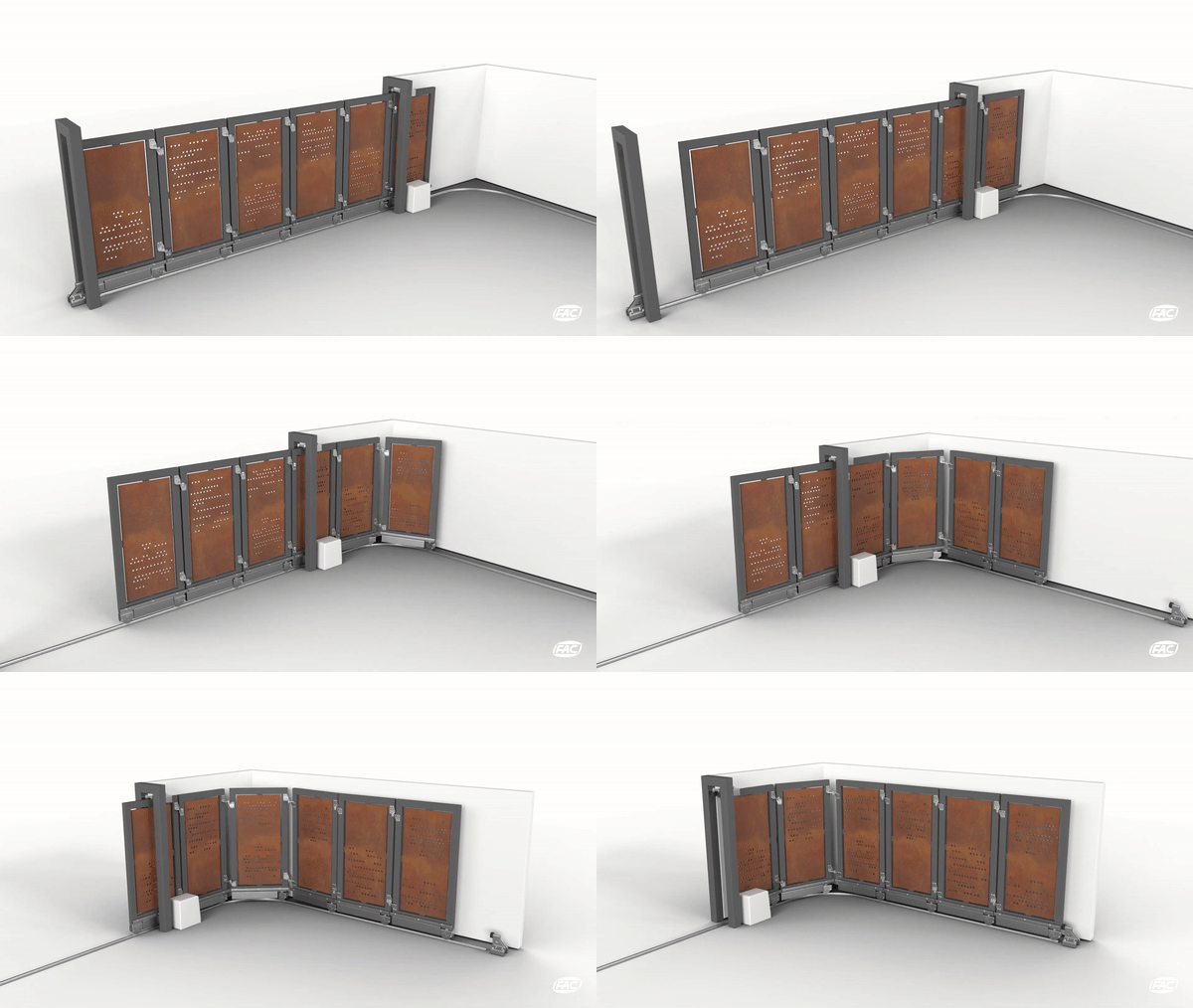
- The gate needs to turn around a corner: Radius curved gate.
Another option is to reduce the required opening width. An explanation of the counterbalance tail and an indicative calculation can be found in How much space does a conventional cantilever gate need?.
What to measure first
- Opening width: the clear opening the gate needs to leave unobstructed when open.
- Space to slide the gate open: the distance from the edge of the opening to the nearest obstacle. Measure both the left and right sides.
- Space alongside the fence: with a telescopic gate, there must also be room for the leaves to stack alongside each other.
- The shape and surface of the property: Mark any corners, slopes, low walls, and places where a track could run.
Cantilever solutions without a track across the opening
1. Intelligate cantilever gate with a short counterbalance tail
When to consider it: you want a cantilever gate, but there is no longer room for a standard counterbalance tail.
Intelligate uses a special telescopic running gear and a different distribution of forces. This allows the cantilever gate to have a significantly shorter counterbalance tail while still operating without a track across the opening.
What to bear in mind: Choose the specific configuration based on the opening width, gate weight, and the dimensions required for it to open fully.

2. Telescopic cantilever gate
When to consider it: you need less room to slide the gate open and want to keep the opening free of a track.
The gate consists of two or three cantilever leaves. As the gate opens, they move simultaneously and slide alongside each other to one side. This reduces the required space compared with a standard single-leaf cantilever gate.
What to bear in mind: you also need room for the counterbalance tails, support carriages, and overlap between the individual leaves. The telescopic drive mechanism must synchronize their movement. Determine the required sliding space from the drawing for the selected kit, not by simply dividing the opening width by the number of leaves.
3. Two opposing cantilever gates
When to consider them: there is not enough room on one side, but you can use the space on both sides of the entrance.
The opening is divided between two cantilever gates. One slides to the left and the other to the right. If divided evenly, each gate covers half of the opening.
What to bear in mind: each gate needs its own counterbalance tail, support carriages, and foundation. For automation, choose operators that support synchronization of opposing gates, and check that the specific models can be connected accordingly.
Solutions with a track across the opening
4. Conventional track gate
When to consider it: there is room alongside the opening for the entire leaf, but not for the counterbalance tail of a cantilever gate.
The gate runs on wheels along a track, so it does not need a counterbalance tail. However, when opening, the entire leaf still slides away in a straight line.
What to bear in mind: The track runs across the opening and along the gate's sliding path. Allow extra space beyond the leaf dimensions for the guides, stops, and installation, as required by the specific design.
5. Telescopic track gate
When to consider it: there is not enough room to slide the entire leaf open, and a track across the opening is acceptable.
Two, three, or four leaves slide alongside each other as the gate opens. Unlike a telescopic cantilever gate, the leaves are supported by wheels running on tracks, so they do not need cantilever counterbalance tails.
What to bear in mind: In addition to space for sliding the gate open, you need room for the leaves to stack alongside each other and for their guides. More sections can shorten the stacked assembly, but mean more components and more complex installation. Determine the exact dimensions from the drawing for the selected kit.
Choose components based on the number of sections: two-section, three-section or four-section telescopic track gate.
6. Radius curved track gate
When to consider it: the gate cannot slide straight alongside the fence, but it can continue around a corner towards the inside of the property.
Radius consists of several sections joined by hinges. As the gate opens, the sections follow a curved track and gradually turn around the bend. Unlike a telescopic gate, the sections do not stack alongside each other; instead, they follow one after another along the track.
What to bear in mind: the entire path, including the curve and the space beyond it, must be clear. The track radius determines the suitable section lengths and the choice of wheels and guides.
7. Reducing the required opening width
If a narrower entrance will work for you, you can reduce the opening structurally, for example by extending the fence. The gate will then cover a narrower opening and need less room to slide open.
Another option is to keep the opening as it is and design a gate that does not clear it completely. In that case, allow for the actual clear width only. Neither the gate leaf nor its anchoring must obstruct the vehicle's path through the opening.
Other common situations when building a sliding gate
How much space does a conventional cantilever gate need?
In addition to the section that covers the opening, a cantilever gate also has counterbalance overhang. This section remains beside the opening and allows the support rollers to be positioned. The total gate leaf length is therefore greater than the width of the opening itself.
The overhang and roller spacing affect the load on the support system and how smoothly the gate runs. Choose their dimensions based on the hardware used, the opening width, the gate’s weight and its construction. A more powerful motor alone will not fix a poorly designed mechanism.
Example for a 4 m opening: with a factor of 1.4 and an additional 0.2 m, the total gate leaf length is 4 m × 1.4 + 0.2 m = 5.8 m. This is an illustrative calculation for a standard cantilever gate, not an installation dimension for every configuration. Do not apply it to Intelligate or telescopic systems.
Before manufacturing, compare the available space with the drawing for the specific kit. Take into account the overlap at the posts, the guide, stops and motor.
We can help you choose the right solution
Prepare a sketch showing the opening width, the clear space on both sides and any obstacles. If you know them, include a photo of the entrance, the planned infill and the approximate weight of the gate. With this information, we can compare suitable systems and the components you need.
Email: [email protected]
Phone: