How to choose components for a gate? 4 main criteria
Complete overview of sliding gate components
It’s easy for a newcomer to get lost in the range of gate components. It’s all C-profiles, rollers, end stops, stops and guides. Our e-shop offers more than 2,000 products, but in this article we’ll show you that choosing the right components is simple.
Cantilever sliding gate
A cantilever gate is built around support carriages that the guide C-profile runs along. One end of the C-profile is covered with an end cap, while the other has a guide roller that guides the gate into the end-stop catch.
The top guide holds the upper part of the gate in place, and an additional top stop can be fitted above the end-stop catch. Stops secure the gate more firmly when closed and take the load off the support carriages so they don’t have to bear the gate’s full weight.
Additional accessories include locks, handles and pull handles. A cantilever gate is typically secured with a hook lock that engages with the post.
| Cantilever gate components | Detail | ||
|---|---|---|---|
 |
Support carriage for cantilever gate | Detail  |
|
|
Carriages can be classified by roller material: nylon, steel or stainless steel; number of rollers: 3, 5, 8, 10; whether they pivot: pivoting/fixed; and height adjustment: adjustable/non-adjustable |
|||
 |
C-profile for cantilever gate | Detail |
|
|
Choose a C-profile based on its size: 60x60, 70x70, 80x80, 100x100, 140x140; finish: standard steel, galvanised steel or stainless steel; and length: from 1 to 6 metres. |
|||
 |
Bottom guide roller for cantilever gate | Detail |
|
|
Choose the guide roller to match the C-profile size. These components are compatible with one another. |
|||
 |
Bottom stop for cantilever gate | Detail |
|
|
Choose the stop to match the C-profile size. These components are compatible with one another. |
|||
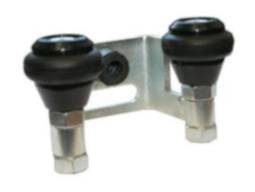 |
Top stop for cantilever gate | Detail |
|
|
Top stops provide greater stability for the gate. They are usually selected according to the width of the gate at the top. |
|||
 |
Gate guide | Detail |
|
|
A gate guide provides vertical stability and prevents the gate from moving sideways. Choose between a top or side guide, depending on the layout. |
|||
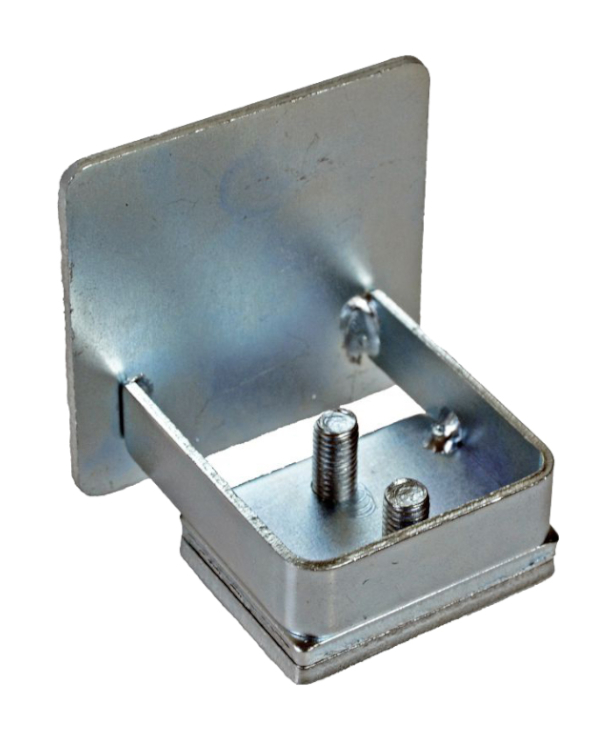 |
Metal C-profile end cap | Detail |
|
|
Choose an end cap for covering the C-profile to match the C-profile size. These components are compatible with one another. |
|||
Track-mounted sliding gate
As the name suggests, a track-mounted gate needs a track and wheels. We offer tracks and matching wheels in two shapes: U-shaped and V-shaped. U-shaped tracks have a semicircular profile with a diameter of 16mm or 20mm, while V-shaped tracks have a 90° V-shaped groove.
We offer wheels for these tracks in various sizes and with different mounting options. The wheels can be bolted or welded to the bottom of the gate.
Other important components of a track-mounted gate are the stop and guide. Whether it’s a bottom or top stop, the gate needs something to stop it from running off the track. The gate guide holds the top of the gate in place and helps it move in a straight line.
Locks, handles and pull handles are also important. For a lock, we also recommend a hook lock, but it must be paired with a locking pin to prevent the gate from being lifted and opened.
| Track-mounted gate components | Detail | ||
|---|---|---|---|
 |
Gate track | Detail |
|
|
Tracks are classified by shape: U-shaped/V-shaped; length: from 1 to 6 metres; finish: galvanised/stainless steel; and mounting method: for bolting or direct casting into concrete |
|||
 |
Gate wheels | Detail |
|
|
Wheels are primarily classified by the shape of the matching track, which they run on: U-shaped/V-shaped. They are also classified by mounting options: bolt-on with bracket/recessed bolt-on/recessed weld-on/individual wheel; finish: galvanised/stainless steel; and wheel diameter: 60/80/90/100 mm. |
|||
 |
Gate bottom stop | Detail |
|
|
The bottom stop is an optional component, but it is included in our kits. The stop can be a bottom or top stop and is used to stop the gate at its end position. |
|||
|
Gate guide | Detail |
|
|
A gate guide stabilizes the gate vertically in the transverse direction. You can choose between a top or side guide, depending on the layout. |
|||
Overhead sliding gate
The name of an overhead gate is also derived from how the gate works. The load-bearing C-section is suspended from the top of the structure. Guide trolleys run inside it, and the gate itself is attached to them.
Stops are also needed to bring the gate to a halt, as well as guide rollers, which in this case are installed at ground level.
This type of gate is used as a sliding partition, sliding door, or warehouse entrance, and in other places where you want a sliding gate but a cantilever or track-mounted gate is unsuitable.
For the overhead system, we adopted the size designations used by our supplier, so most overhead products are grouped by size as picollo, medio, and grande.
| Components for an overhead gate | Detail | ||
|---|---|---|---|
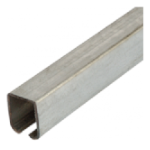 |
C-sections for overhead gates | Detail |
|
|
The guide C-sections for overhead gates differ from the C-sections used for cantilever gates. Their main distinguishing features are their smaller dimensions and lower weight. Choose an overhead gate C-section according to its size: picollo/medio/grande; length: 1 to 6 metres; and finish: galvanized/stainless steel. |
|||
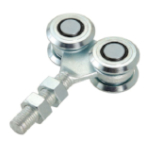 |
Trolleys for overhead gates | Detail |
|
|
Guide trolleys are also classified by size (to match the corresponding C-section): picollo/medio/grande. They are further classified by number of rollers: 2/4; roller material: metal/nylon; and trolley material: metal/stainless steel. |
|||
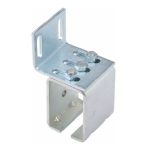 |
C-section brackets | Detail |
|
|
C-section brackets are also classified by size (to match the corresponding C-section): picollo/medio/grande; and mounting method: side-mounted/top-mounted. |
|||
|
Bottom gate stop | Detail |
|
|
The stop can be a bottom or top stop and is used to stop the gate at its end position. |
|||
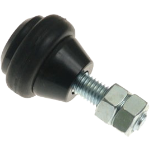 |
Guide rollers | Detail |
|
|
A gate guide stabilizes the gate vertically in the transverse direction. On an overhead gate, the guide mechanism is at the top of the gate, so a guide is needed at the bottom. Rollers anchored to the ground are sufficient for this. |
|||
How to choose components for a sliding gate
We have briefly explained the components, but how do you choose the right components for a sliding gate?
- Clear opening width + total space available for the gate
- Gate weight
- Gate material (Fe, Zn, Inox)
- With or without an operator
Once you have these four points clear, choosing the right components takes just a few minutes. You can choose a pre-assembled kit based on the clear opening width and gate weight, or give us a call and we’ll be happy to advise you.